So it looks like my old blog theme just went crazy and exploded in two thousand pieces..
I’m going back to the standard one just for the sake of accessibility..
I’ll try to fix it ASAP!
So it looks like my old blog theme just went crazy and exploded in two thousand pieces..
I’m going back to the standard one just for the sake of accessibility..
I’ll try to fix it ASAP!
Marimokkori is a character popularized in Hokkaido, Japan. Much like the Tamagochi, the name “Marimokkori” is a pun: marimo is the word for the green algae clusters that grow in some of Hokkaido‘s lakes, while mokkori is a Japanese slang term for an erection.
Marimokkori’s fame comes through merchandising, with a number of various souvenirs being sold in Hokkaid? and throughout Japan.
And here’s a Morimokkori boy band:
httpv://www.youtube.com/watch?v=ejcWydndQuw
If you’re interested, you can also buy a Marimokkori CD (a great idea for Xmas ahah!)
UPDATE: I added the lines to recognize Android, iPod Touch and Palm WebOS!
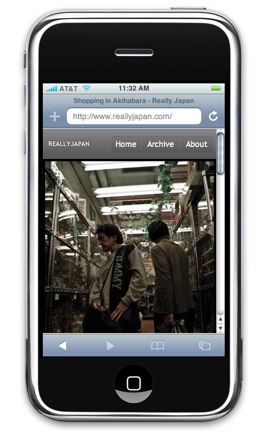
Chris, a reader of this website (and a cool photographer, check his website Intelligent Cloud), asked me how I did to setup an iPhone friendly version of ReallyJapan Photoblog and automatically redirect the users with an iPhone to this website.
As you know, ReallyJapan is using Pixelpost, a free photo blog application. Pixelpost has many great templates, and one of them, Hoo is an iPhone optimized template.
The problem is that in Pixelpost control panel you can select only one template, and there’s no option to specify one template for certain users and a different one for the others.
So, while the Hoo template is a great solution for iPhone users, if you configure Pixelpost to use this template, all your users will see the Hoo template, no matter if they’re using iPhone, Internet Explorer, Firefox or a cyberdeck Ono-Sendai (in that case they’ll probably just look to the code).
So, what do we need to do?
Simple: When someone visits our Pixelpost photoblog, check if they’re using iPhone, and just in that case tell Pixelpost to use Hoo template instead of the one we selected in the control panel.
It requires some changes in a php file, but it’s very simple. Let’s start:
B. Now Search the file for this text: // get config
You’ll find this code:
// get config
if($cfgrow = sql_array(“SELECT * FROM “.$pixelpost_db_prefix.”config”))
{
$upload_dir = $cfgrow['imagepath'];
}else{
$extra_message= “Coming Soon. Not Installed Yet. Cause #1″;
show_splash($extra_message,”templates”);
}
What does it do? Ok, basically it’s reading the configuration of your Pixelpost installation from the database (you know all the stuff you selected in Pixelpost control panel like paths, name of the blog and.. the template).
The first case of the IF statement means Pixelpost has been installed while the ELSE case means (as you can see in the extra_message) that.. well, it’s not installed yet.
So, let’s add some code here (blue text):
// get config
if($cfgrow = sql_array(“SELECT * FROM “.$pixelpost_db_prefix.”config”))
{
$template_dir=”hoo”;
}else{
$template_dir=$cfgrow['template'];
}
$upload_dir = $cfgrow['imagepath'];
}else{
$extra_message= “Coming Soon. Not Installed Yet. Cause #1″;
show_splash($extra_message,”templates”);
}
Basically: If Pixelpost has been installed (IF case 1), check if the user agent of the visitor is iPhone, iPod, Android or webOS.
In that case set $template_dir to ‘hoo’ (the hoo template, in the folder /template/hoo on your webhosting).
Otherwise set $template_dir to $cfgrow['template'] (the default template you selected on Pixelpost control panel).
C. Save the file and..
That’s it!
From now on the iPhone users will see the Hoo template while all the other users will see the default template.
If you have any question please write a comment!

Now you can check the Top Shots of ReallyJapan.com by page views!
Just go to Archive and select Top Chart.. or just follow this link, that’s it!
What’s great about Pixelpost is the wide selection of templates and addons available.. and if you’re not satisfied, creating a new cool template or a useful addon is relatively easy.
So, let’s take a look to the best Pixelpost templates out there.
Dark Matter
Dark Matter is a great theme with some cool fancy Ajax animations and a carousel effect to browse your photos.
You can find a Free version of this template and a Pro version with various extras (it’s $49.95). And yes, ReallyJapan is using a customized version of the free version.

Free version Demo
Pro version Demo
Dark Matter’s Home Page
Download Dark Matter
Switchy
Switchy is an interesting template that changes its layout according to the orientation of the photo.
The layout is very clean and easy to customize.
![]()
Check the demo here
Download Switchy
Pixelfy
Very clean and simple layout that let’s your photograph speek for it self. It wraps around both big and small images.

Check the demo here
Download Pixelfy
Delicious
Delicious is a fresh and tastey photoblogging template for Pixelpost. It’s a very nice theme and I’ve used it for the first version of ReallyJapan.com.

Check the demo here
Download the updated version by Andrew here
The World in 35mm
An extremely clean, modern and simple template for pixelpost you’re going to love, I do. One of the best IMO.
Try the demo here
Download from here
Pixelution
If you want a template with an unusual layout and some interesting features, check this out.
![]()
Check the demo here
Download Pixelution
Hoo! (Pixelpost template for iPhone)
Well, have you ever visited ReallyJapan.com using your iPhone? Well, you should, because it uses this template to offer you an iPhone customized version.
Now, you need to mess a little with php and your pixelpost installation to have the browser detect if you’re using an iPhone or a regular browser and switch the template… It’s not hard, but it’s not extremely easy.. I did it and maybe, if someone is interested, I could write a small tutorial on how to use this template in the future..

Focus
A simple, dark and clean template.

Check the demo here
Download Focus
Photographer’s Template
A template geared more towards a self promotional site for photographers.

Try the demo here
Download the template
Raia
A very nice template with a new, fresh web2.0 look.
In my spare time, besides going out on the street taking photos, I also enjoy building plastic models of robots.
I don’t like so much Gundam, too much fantasy sci-fi for my taste, instead I prefer more realistic sci-fi models like Votoms or Maschinen Krieger. The design is great, rusty, hard sci-fi look and dirty.. not shiny armours for me, but blood on the steel!
Maschinen Krieger ZbV 3000 is a science fiction universe created by Japanese artist and sculptor Kow Yokoyama in the 1980s. It originally began as the science fiction series SF3D which ran as monthly installments in the Japanese hobby magazine Hobby Japan. To develop the SF3D storyline, Kow collaborated with Hiroshi Ichimura (story editor) and Kunitaka Imai (graphic designer).
The creators drew visual inspiration from their combined interest in WWI and WWII armor and aircraft. Kow built the original models from numerous kits including armor, aircraft, automobiles and real space.
The designs were predominantly of powered armor suits, but Kow also created two legged walking tanks, anti-gravity flying aircraft, and automated robot walkers. Hiroshi Ichimura and Kunitaka Imai added the graphic style and created the background story for the new models.
Together they created a unique series with a very different visual style from the typical “Giant Robot” series in Japan at the time. A small but dedicated fan following soon developed.
The Story
The story is set 880 years in the future. Events primarily take place between the years 2882 and 2886. A nuclear World War in 2807 destroys most of Earth’s population, and renders the planet uninhabitable. About 50 years after the destruction, the Galactic Federation (details unknown) sent an investigative team to determine the condition of the planet. They discover the planet has restored itself to a natural paradise and begin the process of sending colonists to populate Earth. The colonists prospered on the reborn Earth. Cities and towns are eventually reformed, but this growth attracts the attention of criminals, AWOL soldiers, political criminals, mercenaries, terrorists, and other people who had decided to leave civilized society, who began to make their way back to Earth as a suitable place for refuge. The Colonists had no real form of government to deal with the problem other than a few local militias. The GF, concerned about the civil unrest and the Colonists forming their own independent government, gave the Strahl Democratic Republic (SDR) the right to govern the planet. The SDR’s hard handed tactics to restore order; travel restrictions, hard labor camps for the unemployed, etc., created great resentment amongst the Colonists. The Colonists create the Earth Independent Provisional Government and declare independence from the Strahl Republic. The SDR immediately forms a puppet government and attempts to quell the uprising. The wealthy Colonists hire the mercenaries to form the Independent Mercenary Army. They attack the SDR forces and the war for independence and the control of the Earth begins.
Some cool pics of Machine Krieger models


Introduction
I’ve started Really Japan Photo Blog and uploaded the very first photo about one year ago.
At the beginning I wasn’t very sure to be able to update the photo blog often, it was not the first time I was starting a blog, but all the previous attempts ended up with failure, after few months.
Fortunately that has not been the case of ReallyJapan.
A lot has happened in this year of ReallyJapan. I’ve learnt many things on photography, met many great photographers, looked at some incredible shots on the web.. and I think if I didn’t start photoblogging, I would have lost many opportunities.
So, after 1 year of photoblogging, I thought it would be cool to write some kind of Guide to Photoblogging.
But, I’m going to tell you a secret: I’m not an amazing photographer or a super blogger, my website is not making trillions of visitors neither, so don’t have huge expectations..
Anyway, I hope this Guide will help all of you who are considering to open a photo blog!
What is a photoblog?
A photoblog (a.k.a. photolog or phlog) is a form of photo sharing and publishing in the format of a blog, but differentiated by the predominant use of and focus on photographs rather than text.
Why photoblogging?
There could be many reasons to start your own photoblog. You may want to show your amazing works to people from all around the world, and consequently make a lot of money with advertising & sales of your photography. Honestly, in that case you’re going to have rough times ahead, good luck.
But if your demands are a little more modest, there are many positive points on opening a photo blog.
Top Advantages of starting a Photo Blog
So.. the list could go on forever, but for this introduction I’m going to stop here.
What should you expect from the next articles of Guide to Photo Blog? Well, something like this:
Joan Charmant is a software engineer who started playing with photo manipulations in 2004, when one day he stumbled upon some UFO pictures and wanted to see how hard it would have been to fake them.
He started spending some days and nights on the website Worth1000.com (there are many great tutorials and competition on photo manipulation in that website, give it a look) and learnt a lot from the other members.
Anyway, his photoshop skills are great and his creative process pretty interesting.. just pity that his day job is software engineer so you can’t find many pics from him on the net (or twitter accounts, blogs, flickr and so on)
I really like his photo manipulations, and you?

Materials used in this picture:


material used in this picture:


material used in this picture:


fantastic materials used in this picture

Source:
An interview with Joan Charmant by Abduzeedo
Joan Charmant home page
The 3rd edition of the International Photography Festival F/Stop takes place from July 1st – 7th 2009 in Leipzig, Germany.
The festival focuses on contemporary national and international photography.
The main program focuses on the changes in live of two generations after the revolution in 1989.
Additionally a symposium on “Curating contemporary photography” will be organized.
Artists can the download at http://www.f-stop-leipzig.de/v3/en/aktuell.php the application form for this year’s international competition called “Where do we go from here?”. The deadline for sending your work is *6th April 2009*.
The finalists will be reviewed by an international jury.
The winner will be invited to join the world’s biggest portfolio review in Houston,Texas (USA) and can present his/her work to famous directors, curators and artists from all over the world.
From Moritz Arnold
F/Stop Festival Team 2009
Do you still think you need a Nikon D300, a Hasselblad or an extremely expensive lens to become a great photographer? Well, think again.
In this video Daido Moriyama explain you how a small compact camera is a lot better than a reflex to take street shots.
Of course, each person has his/her own style, maybe you (and me too) like to have the quality and versatility of a DSLR.. try to think If Ansel Adams have had just a compact camera to take photographs…
But the main points here are:
So, next time you have a slow lens, no flash, and you want to take street shots at night.. Don’t say it’s impossible, just bump your iso and use you camera creatively!
Ahh, too bad, the video has been removed by Youtube due to terms of use violation